
Sex Offender Checks in Wasatch County
The Utah Department of Public Safety maintains the Sex, Kidnap, and Child Abuse Offender Notification and Registration website under Utah Code Title 53, Chapter 29. The statewide interface provides the official Wasatch County search layer. State law requires indexing by surname and postal code, while the live system also supports location-oriented controls after the visitor accepts its conditions.
Wasatch County Sheriff's Office has the local residence-jurisdiction role for people who are not under state supervision and live in its service area. Utah Department of Corrections Adult Probation and Parole handles in-person registration for supervised people. The registry office can answer program questions at 801-495-7700 or registry@utah.gov. Each office has a separate task, so the public portal remains the best first stop for community awareness.
Wasatch Registry's New Legal Framework
Utah moved the current registry framework into Title 53, Chapter 29 through changes spanning 2025 and 2026. The transition matters because older summaries may cite former section numbers or describe the system with outdated terms. The current public-site rule is Utah Code §53-29-404. It governs website content, surname and postal-code indexing, identifier checks, and the anti-harassment warning.
Searchers should use the current statute and live profile rather than a cached list. Registration duties are offense-specific, supervision-specific, and sometimes tied to another jurisdiction. The legal update did not turn Utah into a simple three-tier public ranking system.
How to Search the Utah Registry
Open the official Utah registry through the Utah Department of Corrections offender-search page. The registry vendor requires acknowledgment of its disclaimer before displaying results. Search by surname when the person is known, or use an address, ZIP code, radius, or map control when the concern is a Wasatch County location. Controls can vary by session.
- Read and accept the registry conditions before using the search form.
- Enter a surname or a Wasatch County address or ZIP code; use spelling variants when appropriate.
- Review the result list and compare the photo, aliases, and physical details rather than relying on name alone.
- Open the full profile and read the offense, status, location, verification, and registration details.
| Control | Type | Required | Use |
|---|---|---|---|
| Disclaimer acknowledgment | Button or checkbox | Yes | Accept official conditions before searching |
| Name | Text | Optional | Surname indexing is required by statute |
| Address or location | Text/geographic | Optional | Supports ZIP or postal-code searching |
| Radius or map | Geographic control | Optional | Availability may vary with interface or session |
| Search/Clear | Buttons | Not applicable | Runs or resets the query |
For a Wasatch County location search, try the street or ZIP view and then open each possible match. A radius can cross city and sheriff service boundaries, but the statewide profile still identifies the official registration record.
Avoiding Wasatch Registry False Matches
A common surname does not identify a person. Compare the current profile photo, aliases, physical description, qualifying offense, address or location, and verification status. A list-row match is only a lead. Open the full public profile and check whether the details fit the person or place being researched.
A map pin also needs care. Geocoding, a recent move, or a reporting update can affect its apparent position. The pin is not a full neighborhood risk measure. If a listing appears wrong or stale, do not edit, repost, or investigate it independently. Report the possible error to registry@utah.gov or 801-495-7700, or use the official Submit a Tip feature when it appears.
Note: Match several official profile fields before drawing any conclusion from a Wasatch County surname result or registry map pin.
Inside a Registry Profile
Section 53-29-404 authorizes public identifying and notification information. The live profile controls what is actually visible. Some data, including vehicle, school, work, or online identifiers, is governed by publication limits and should not be assumed present. Juvenile external-jurisdiction entries may be maintained without publication when the adjudicating jurisdiction does not publish them.
| Name and aliases | Legal name and other names made public for accurate identification. |
|---|---|
| Photo and description | Photo plus public physical traits such as sex, race, height, weight, hair, and eyes. |
| Address or location | Residence or other location information published under the current rule. |
| Qualifying offense | Offense, statute, jurisdiction, and conviction information shown by the profile. |
| Status and verification | Registration status, last verification, and other compliance details made public. |
| Other identifiers | Vehicles, marks, tattoos, or other fields only when the live public profile displays them. |
Read status and verification data with the address. If the Wasatch County registry profile conflicts with direct knowledge, send the profile link to the Registry Office or WCSO rather than treating the discrepancy as confirmed noncompliance.
Wasatch Registry Versus NSOPW
The Utah registry supplies the state-law profile and Wasatch County location view. The U.S. Department of Justice's National Sex Offender Public Website searches participating jurisdictions across the country. It is useful when a person has moved, an address is near a state boundary in another search, or a name may appear outside Utah. NSOPW supplements rather than replaces the state profile.
- Utah registry
- Covers Utah statutory records and starts with a surname, ZIP, or Utah location. The live Utah profile supplies the detail, with WCSO or the Registry Office handling local follow-up.
- NSOPW
- Covers participating U.S. jurisdictions through name or location searching. Its information comes from those jurisdictions, so follow-up belongs with the agency that supplied the result.
The official national search page shows the broader comparison layer.
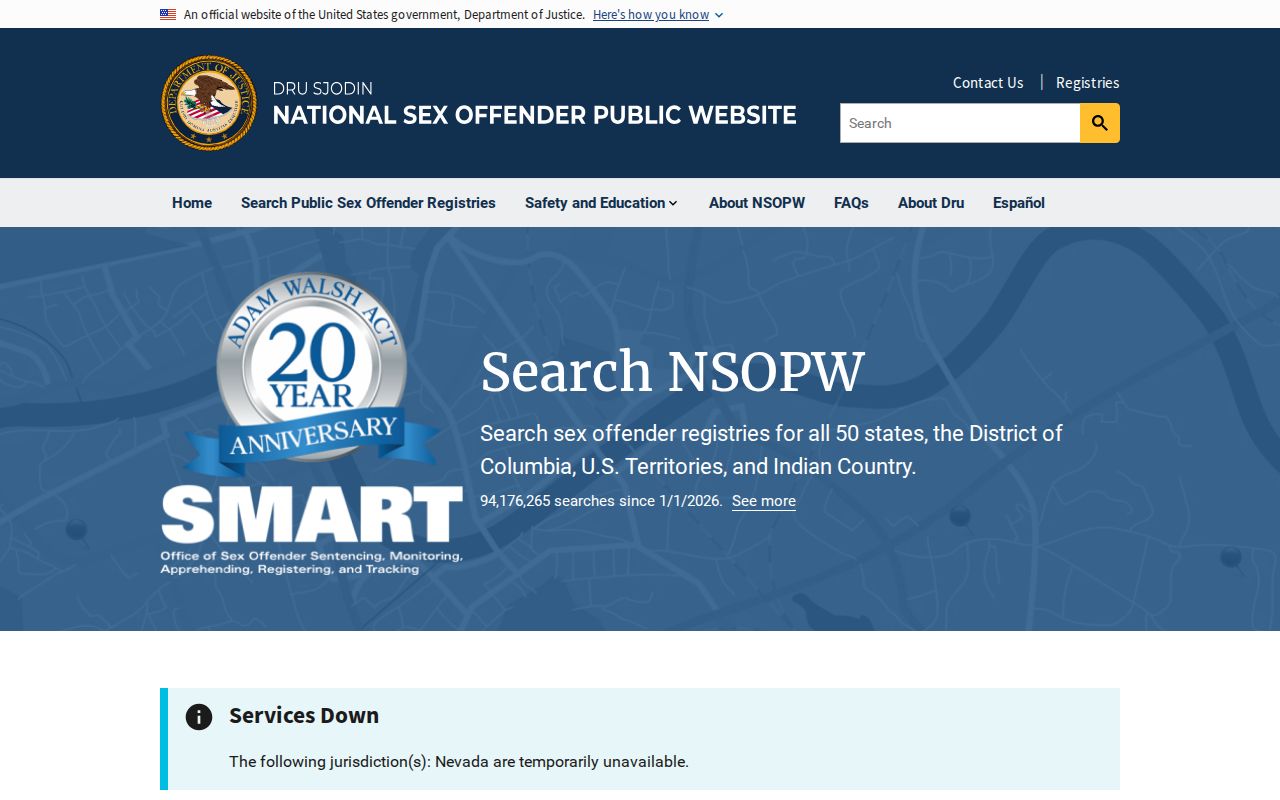
Return to Utah's full profile for the current state-specific duties and local contact route.
Utah Registration Levels and Requirements
Utah does not reduce registry duration to a simple public risk tier. Under Title 53, Chapter 29, duration depends on the qualifying offense, sentence termination, outside-jurisdiction duty, and other statutory conditions. Some duties last ten years after sentence termination, while enumerated offenses require lifetime registration. Noncompliance can add time.
| Framework | Duration or rule | Registration channel |
|---|---|---|
| Time-limited enumerated duty | Generally ten years after sentence termination under §53-29-203 | AP&P if supervised; residence police or sheriff if not |
| Lifetime enumerated duty | Lifetime for offenses specified by §53-29-203 | Same supervision and residence-jurisdiction split |
| External jurisdiction | The outside duty may control | Confirm with the Utah Registry Office |
| Petition route | Specified ten-year route may apply if §53-29-205 conditions are met | Formal court process, not a portal edit |
Registration information can include aliases and residences, physical description, photo, fingerprints or DNA if absent, phones, vehicles under statutory conditions, online identifiers, and passport details. A local agency may assess up to $25. After July 1, 2026, the state fee is department-set, but the research did not locate a current amount.
Wasatch County Registry Monitoring
Local law enforcement monitors registrants under §53-29-308. A nonsupervised person registers in person with the police department or sheriff that has jurisdiction over the residence. A supervised person uses Utah Adult Probation and Parole under §53-29-304, with AP&P supervision duties also reflected in §53-29-309. In WCSO territory, the Wasatch County Sheriff's Office is the local contact for suspected noncompliance.
Report a concern through nonemergency law enforcement rather than confronting the person or attempting surveillance. WCSO's main line is 435-654-1098, and shared nonemergency dispatch is 435-654-1411. Give the official profile link and a clear description of the suspected mismatch. An urgent threat belongs with emergency services.
The county department directory can confirm local routing. A request for an existing sheriff-held administrative record may use the Wasatch County GRAMA gateway, but that route does not edit the statewide registry profile.
Wasatch Registry Removal and Expungement
Criminal expungement under Utah Code §77-40a restricts an arrest, investigation, detention, or conviction record. Registry removal follows different statutes and does not happen merely because an eligible criminal record was expunged. Section 53-29-205 offers a specified ten-year petition path only when the offense, time in the community, recent record, treatment, restitution, and other conditions are met. Other routes appear in §§53-29-204 through 207.
The BCI forms catalog separates adult, juvenile, verification, pardon, vacatur, and registry-removal materials.
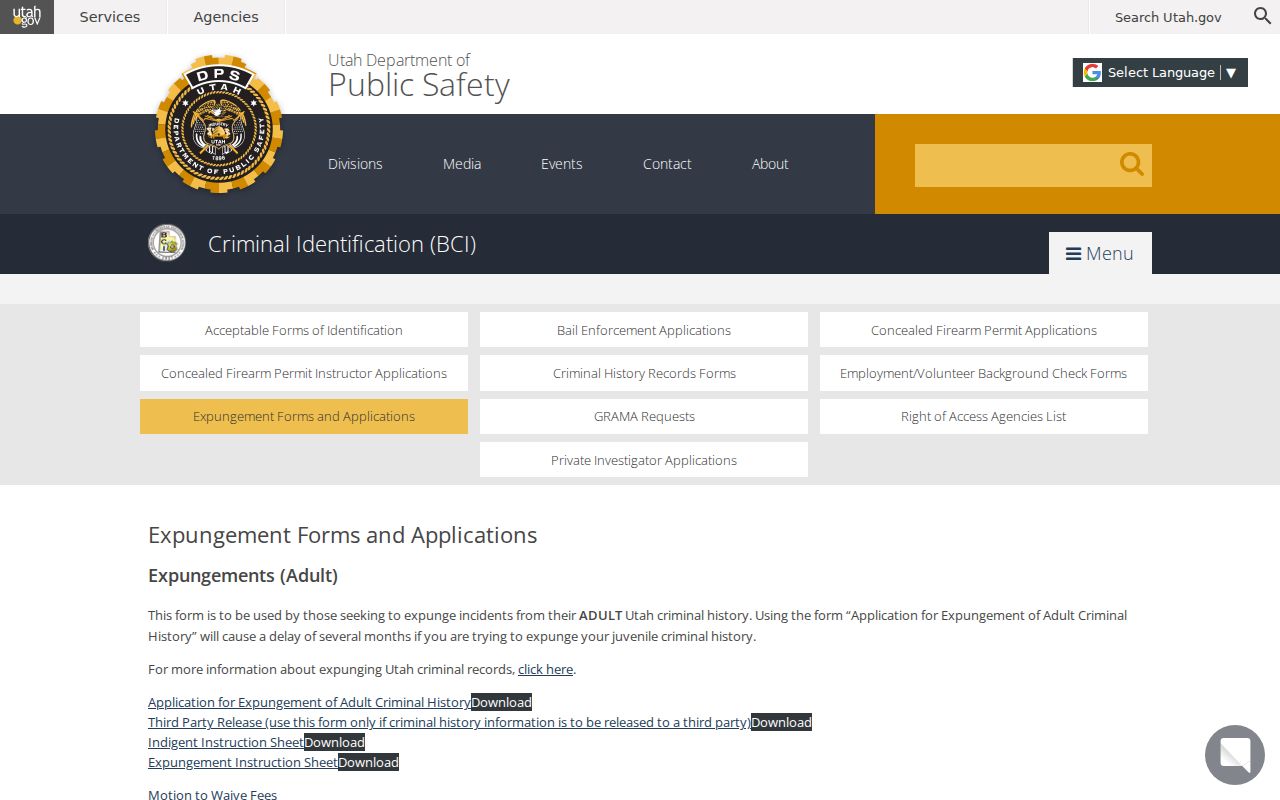
The separate form routes shown here illustrate why a registry profile cannot be removed through a routine record-correction request.
A person seeking relief should confirm the current statutory path before filing. Eligibility for one form does not promise registry removal, and a public searcher should not infer that an absent profile proves a court case never existed. The court, BCI, Registry Office, and arresting agency can hold different products under different access rules.
Community Notification and Lawful Use
The registry exists for public safety information and lawful community awareness. It is not a full list of every criminal case or every person who might present a risk. A profile reflects a qualifying adjudication and a statutory registration duty. Read the actual profile, note its verification status, and use it to make calm safety plans.
The official disclaimer says its information comes from registrants and may not be complete or fully accurate. A phone-number, online-identifier, or website check allowed by §53-29-404 returns only whether that identifier is linked to a registrant. It does not disclose the person's identity and does not itself start an investigation.
Use registry data lawfully: Utah Code §53-29-404 warns that harassment, stalking, or threats against a registrant or family are prohibited and may violate criminal law. Do not confront or retaliate.