
Wasatch County Criminal Court Cases
Offense level determines which clerk holds a Wasatch County criminal case. The Fourth District Court in Heber hears every felony and class A misdemeanor filed in the county. Wasatch County Justice Court hears most class B and class C misdemeanors, infractions, traffic cases, and matters from unincorporated areas. Heber City Justice Court maintains its own municipal docket. A name search should cover both district and justice jurisdiction unless the charge level or citation already identifies the right court.
The Fourth District Court and County Justice Court sit at 1361 South US Highway 40 in Suites 110 and 100. The clerk, not the sheriff or jail, is the custodian for filed pleadings, docket entries, minutes, orders, and judgments. The County Attorney prosecutes felonies and county matters from a separate office at 805 West 100 South. The official Wasatch County Attorney court listing helps confirm the court route before a visit.
The official county court-location page also provides a useful view of the local court arrangement.
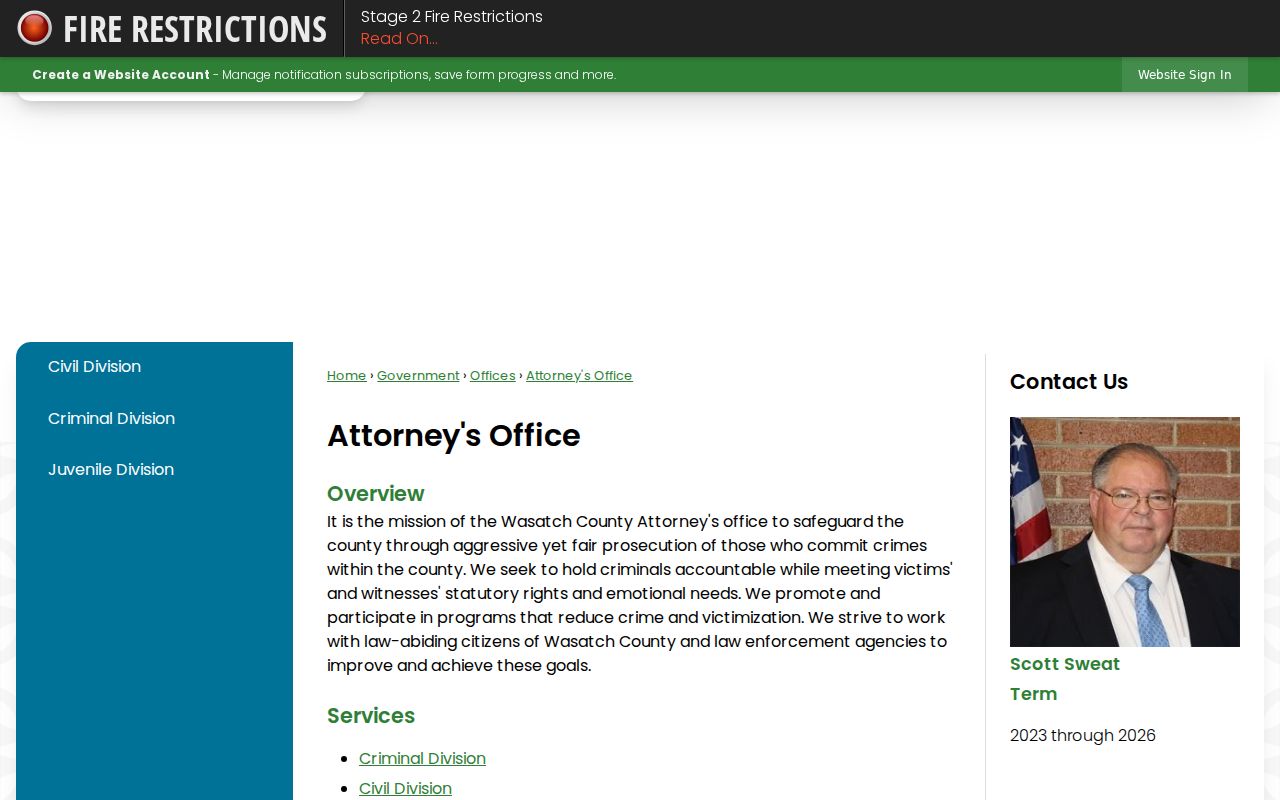
The image reinforces why a searcher must choose a court custodian rather than treat the shared justice campus as one records office.
Wasatch Court Levels by Charge
Utah classification terms point to the likely Wasatch County court. First-, second-, and third-degree felonies belong in district court, as do class A misdemeanors. Class B misdemeanors may carry up to six months, while class C misdemeanors may carry up to ninety days; those lower cases usually begin in justice court. An infraction carries no term of imprisonment as an infraction penalty. These maximum ranges do not predict the actual result.
- Filed charge
- The count the prosecutor placed before the court, which may differ from the arresting officer's initial allegation.
- Amended charge
- A count changed after filing, often by a later pleading or negotiated resolution.
- Disposition
- The result recorded for one count, such as dismissal, plea, acquittal, or conviction.
- Judgment
- The court's formal final ruling, which should be read before drawing conclusions from an earlier docket entry.
Use the filed level to locate the court, then check later entries for a reduction or amendment. A booking label alone does not settle which Wasatch County clerk ultimately received the case.
Searching Wasatch County Case Records
Xchange: Public Case Search is the main remote index for Utah district and justice cases. It draws from CORIS, the court information system, and displays a local entry as soon as court staff enter it. Searchers can avoid weak matches by combining a name with birth date, case type, and Wasatch County or a specific court. Case and citation numbers are not unique statewide.
- Open Xchange and choose district court, justice court, or both based on the charge level.
- Enter a case number when known, or use surname and first name with spelling variants.
- Narrow the scope to Wasatch County or the named Heber court, then add birth date or case type.
- Open the matching docket and read every charge, filing, hearing, order, and disposition.
- Ask the correct clerk for a certified copy when proof of a judgment or order is needed.
| Field | Type | Required | Use |
|---|---|---|---|
| Jurisdiction | Choice | Unspecified | District, justice, or both |
| Case number | Text | Conditional | Narrow by court because numbers are not statewide-unique |
| Last name/company | Text | Conditional | Supports a wildcard |
| First name | Text | Optional | An asterisk can capture variants or a middle initial |
| Birth date | Date | Optional | Helps separate common names |
| Scope and case type | Choice | Optional | Limit to county, court, and relevant case class |
The official Xchange screen shows why the jurisdiction and scope controls matter in a Wasatch County court search.
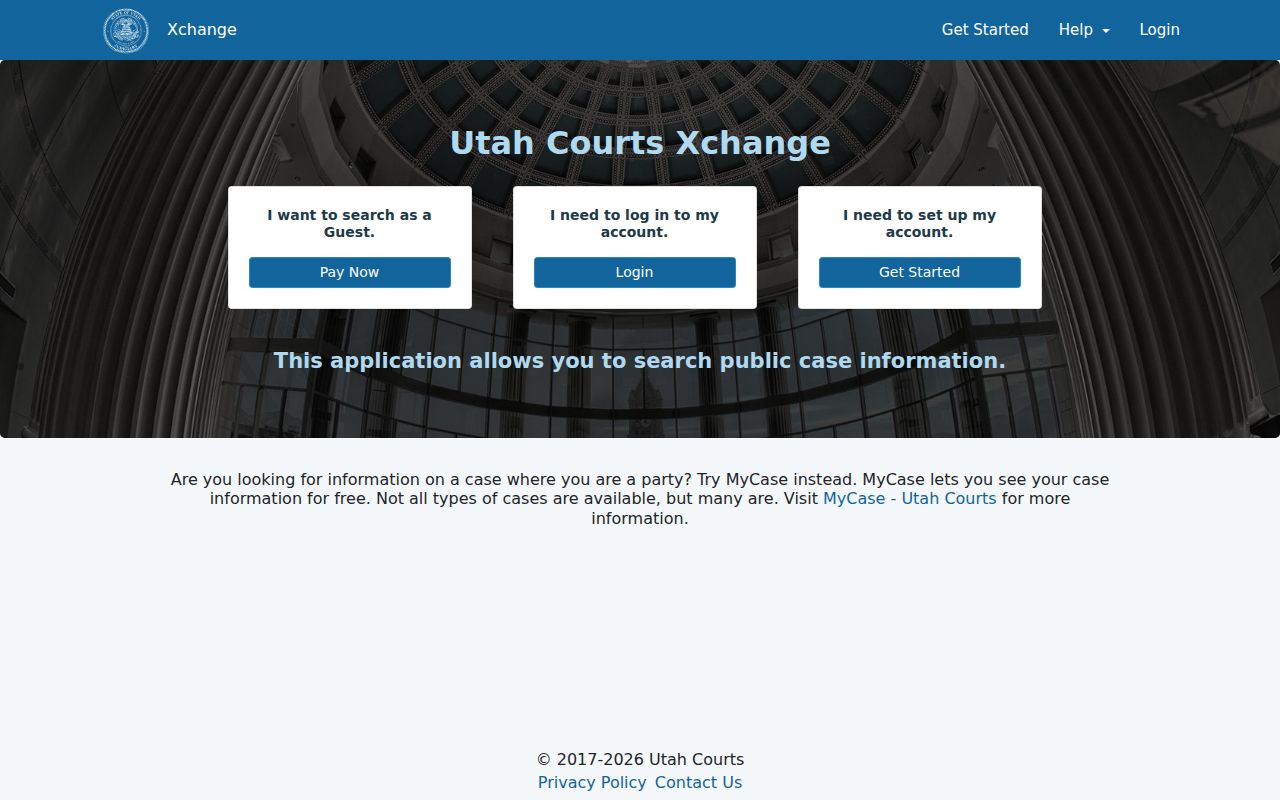
Use those filters before opening a result, then confirm the assigned court and full case number inside the docket.
Wasatch Xchange Costs and Access
Xchange offers a one-time account and a monthly subscription. The inspected registration screen listed a $10 entry fee, searches at $0.20 each, and documents at $1 each. The subscription listed $40 per month plus a $25 setup fee and 500 searches. Utah Courts' separate fee page listed $0.35 per search, creating an official conflict. Confirm the price during checkout instead of relying on either figure alone.
Public electronic district-court images filed since July 1, 2010 may be purchased when their classification permits access. Justice records and older converted files can be thinner. Guest credit may be lost when a session closes, and the inspected system noted a thirty-minute idle timeout.
The official Xchange registration page presents the current account choices.
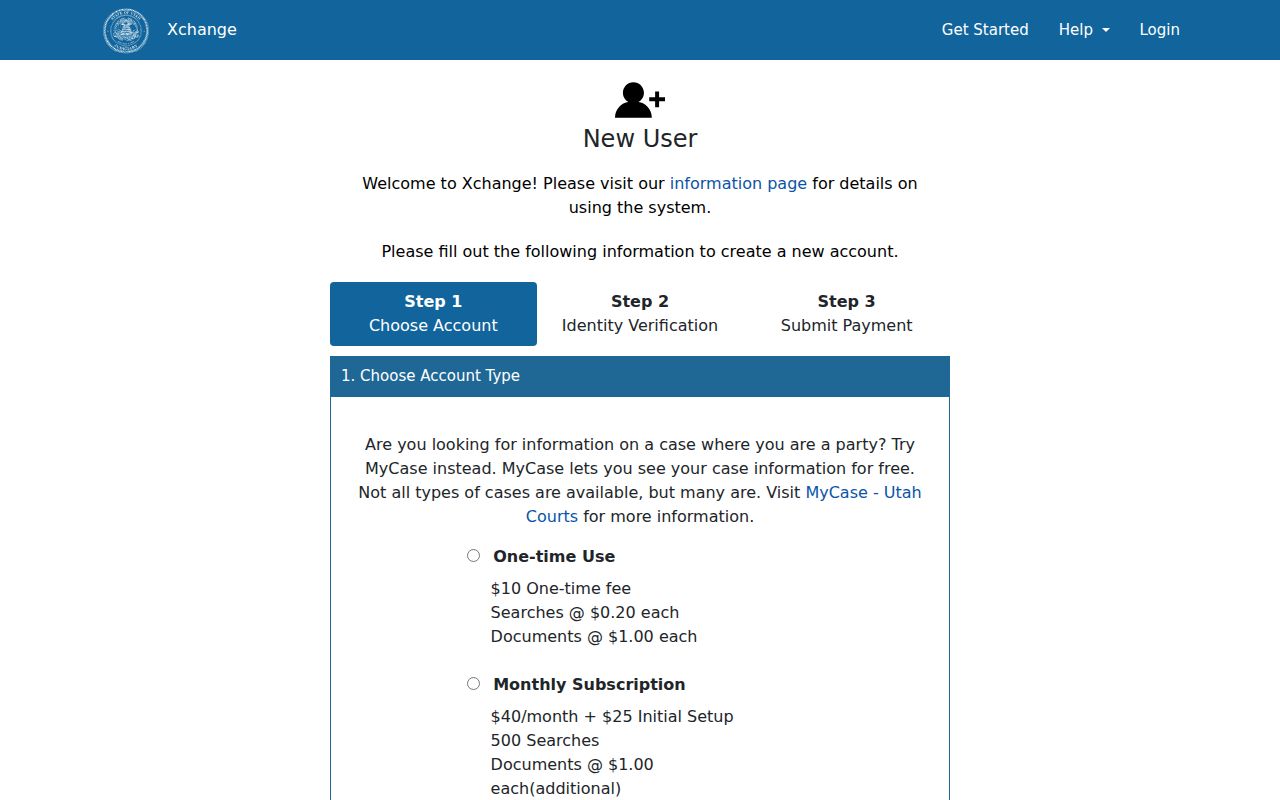
The account image is a prompt to check live terms before paying, especially where two official pages state different per-search prices.
Inside a Wasatch County Case File
A Wasatch County criminal case file records the court proceeding, not the full police investigation. Start with the header and assigned court, then move count by count. A case can contain several charges with different outcomes, so one status label rarely tells the whole story. Later motions, corrections, and appeal entries may alter how an older judgment should be understood.
| Case header | Court, case number, filing date, case type, judge, and current status. |
|---|---|
| Parties | Public names and roles, attorneys, and an address only when available and public. |
| Charges | Description, code, level, amendments, and a separate disposition for each count. |
| Docket history | Filed-document index, hearings, minutes, orders, and judgment entries. |
| Documents | Public images when electronically filed and not restricted. |
| Outcome | Disposition date and type, judgment, sentence, and later orders when reported. |
Certified proof comes from the clerk. A screen image may be useful for research, but it is not a certified court record.
When Wasatch Dockets Look Sparse
Most district courts used CORIS by the end of 1998, while justice-court conversion dates varied. An older Wasatch County justice case may therefore show a short index without the details available in a newer electronic case. That does not prove the missing event never occurred. Contact the listed clerk and ask whether an older paper, archived, or converted file exists.
A free Xchange terminal is available at most district courthouses, and the Utah State Law Library offers another no-subscription route. Call Fourth District Court at 435-654-4676 before traveling to confirm terminal access and counter hours. MyCase is a separate free service for parties in many of their own cases, though it does not cover every case type.
Note: A sparse converted docket calls for clerk follow-up, not assumptions about the charge, judgment, or final Wasatch County outcome.
How a Criminal Case Moves
The court file starts when the prosecutor files a charging document. At arraignment, the accused hears the charge and enters a plea. Pretrial entries can record scheduling, discovery disputes, motions, and changes to the filed counts. A plea or trial produces an outcome, followed by judgment and sentencing where required. Later motions or appeals can add another layer.
Wasatch County case flow: Charges Filed › Arraignment › Pretrial › Plea or Trial › Disposition › Sentencing
An arrest can precede this flow, but it is not a court stage. If prosecutors decline to file, there may be no criminal case docket matching the booking. When charges are filed, compare the original arrest allegation with each filed and amended count. The final judgment deserves the most weight.
Wasatch Court File Versus BCI
Xchange and a Utah Bureau of Criminal Identification history answer different questions. Xchange is a public court-case index. A BCI Right of Access report is the subject's fingerprint-supported Utah repository history. It can associate identity data with arrest cycles and court dispositions submitted to BCI, but Utah does not offer unrestricted public name browsing of those records.
| Point | Wasatch court file | BCI history |
|---|---|---|
| Custodian | Utah court clerk | Utah Department of Public Safety, BCI |
| Key | Name, case number, court | Fingerprints and subject identifiers |
| Best use | Read filed charges and court outcome | Review one's Utah repository record |
| Correction | Contact the court about its docket | Use BCI Record Challenge with support |
If a disposition differs, obtain the certified Wasatch County judgment and compare its case number and charge to the BCI event. BCI offers a $20 Record Challenge Request for the subject, supported by fingerprints and relevant court or agency documents.
Federal Cases Beyond Wasatch Courts
A federal offense arising in Wasatch County belongs in the U.S. District Court for the District of Utah, not Fourth District Court. PACER provides federal dockets and documents through an account. In 2026, its researched rate is $0.10 per page with a $3 cap for many single documents and a quarterly waiver when charges total $30 or less. Name searches and transcripts do not receive the document cap.
The District of Utah locations page identifies the Orrin G. Hatch U.S. Courthouse in Salt Lake City as the Central Division location.
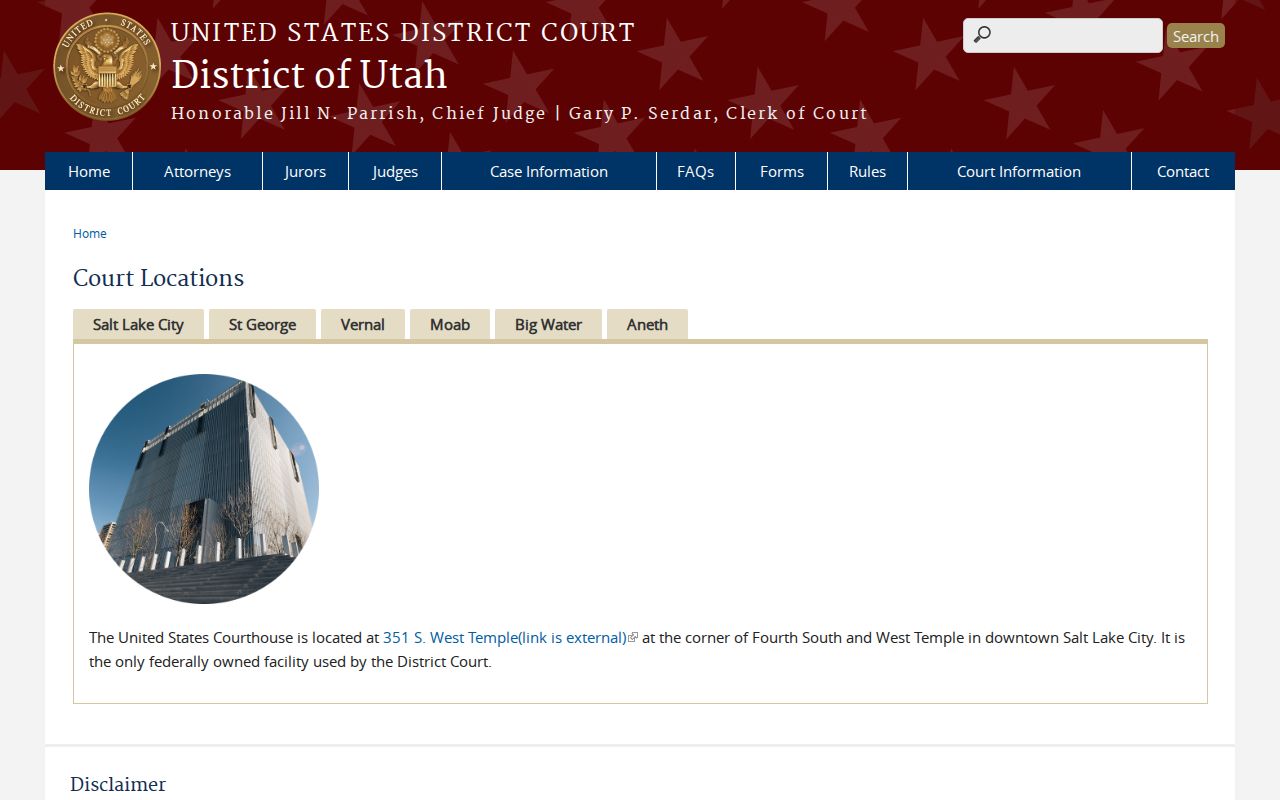
This federal layer should be checked only when the facts point to federal prosecution, custody, or an appellate record.
Case Record Access & Restrictions
Court records follow Utah judiciary access rules, including Rule 4-202.02, rather than simply using the executive-branch GRAMA process. Xchange omits sealed and expunged cases, juvenile delinquency, child-welfare matters, and other nonpublic records. Public summaries should not be expected to expose victim identifiers, a full date of birth, or private documents.
When a Wasatch County case does not appear, first verify spelling, birth date, court level, and jurisdiction. Then ask the clerk whether the file is older, converted, restricted, or held by another court. Under the Utah Expungement Act, an expunged case is removed from ordinary public access, while limited agencies may retain restricted access. A missing public result is therefore not proof that no event ever existed.
Access point: Ask the clerk for segregable public portions and a certified judgment when the online summary is incomplete or a formal record is required.