
Checking Criminal History in Wasatch County
No single public screen contains every Wasatch County criminal record. Begin with the kind of event you are trying to confirm. Utah Courts Xchange is the broad public source for filed district and justice court cases. The Wasatch County Sheriff's Office keeps its own incident, arrest, booking, jail, and warrant-related material. The Utah Department of Public Safety, Bureau of Criminal Identification, or BCI, provides a fingerprint-supported Utah history to the person named in that record. Utah Department of Corrections records cover state custody, probation, and parole.
Collect a full name, spelling variants, date of birth when available, an approximate event date, and any court, citation, or case number. A common name alone is weak evidence. In Xchange, narrow the scope to Wasatch County and the likely court because case and citation numbers are not unique across Utah.
- Search Xchange for the filed case and narrow the court and county filters.
- Compare names, birth date, filing date, charge level, and court before selecting a result.
- Ask the arresting agency for its report and the county jail for a separate booking or custody record.
- Read each filed or amended count through its final disposition instead of treating the first charge as the outcome.
- Use BCI for your own Utah history or the clerk for a certified copy when an official source document is needed.
Xchange Wasatch County Criminal Case Records
The official Utah Courts description of Xchange explains its statewide district and justice court coverage, document access, and courthouse alternatives. The captured interface below shows why a Wasatch County search needs more than a name.
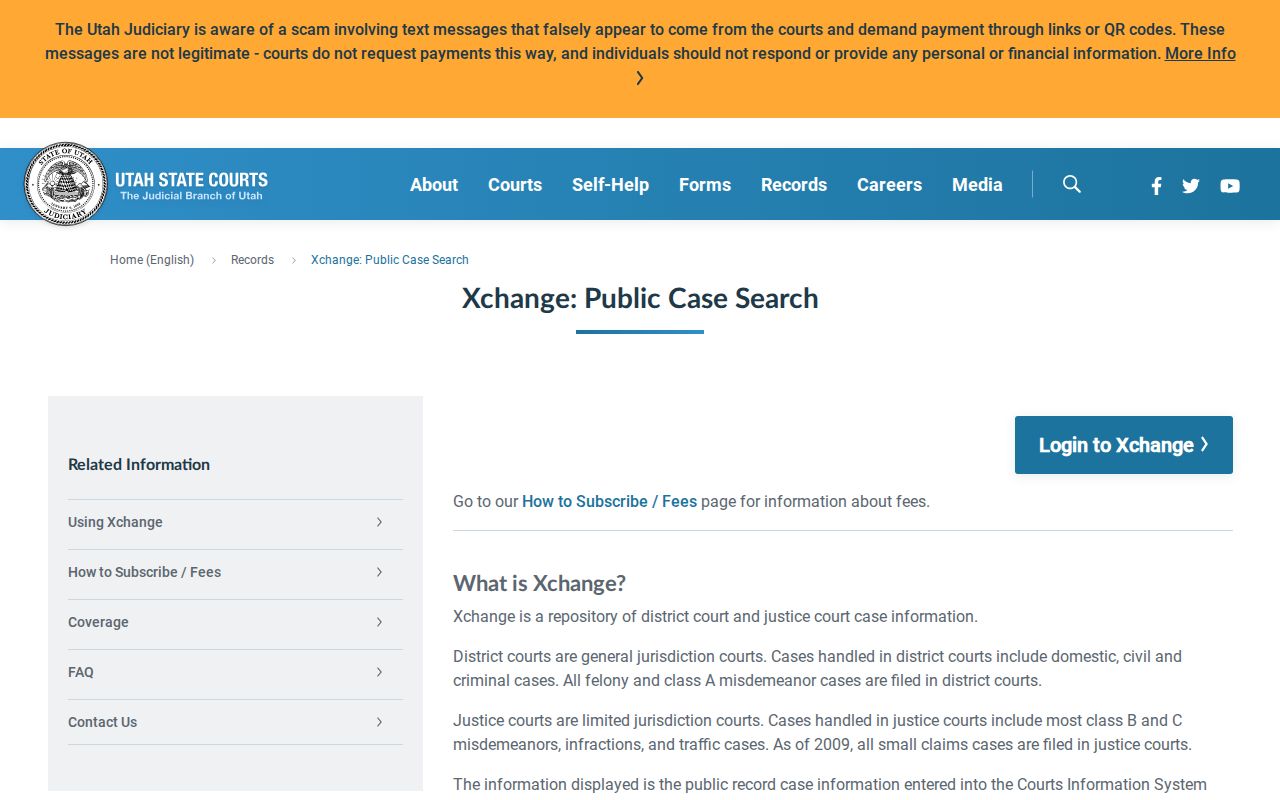
Xchange data appears after court staff enter it in CORIS. Sealed or expunged cases, juvenile delinquency, child welfare, and other nonpublic material are excluded. Older converted justice court cases can also be sparse. Public district court documents filed electronically since July 2010 may be available for purchase, while free terminals at most district courthouses offer an alternative to a paid remote account.
| Search field | Best Wasatch County use |
|---|---|
| Jurisdiction | Select district, justice, or both based on the possible offense level. |
| Case number | Pair it with a county or court because the number is not unique statewide. |
| Last and first name | Try spelling variants or a wildcard, then verify the person with other fields. |
| Case type and scope | Narrow results to criminal matters and Wasatch County or a named court. |
| Birth date | Use it to reduce false matches among people with similar names. |
| Citation number | Treat it like a case number and add a jurisdiction filter. |
Utah Official Background Checks
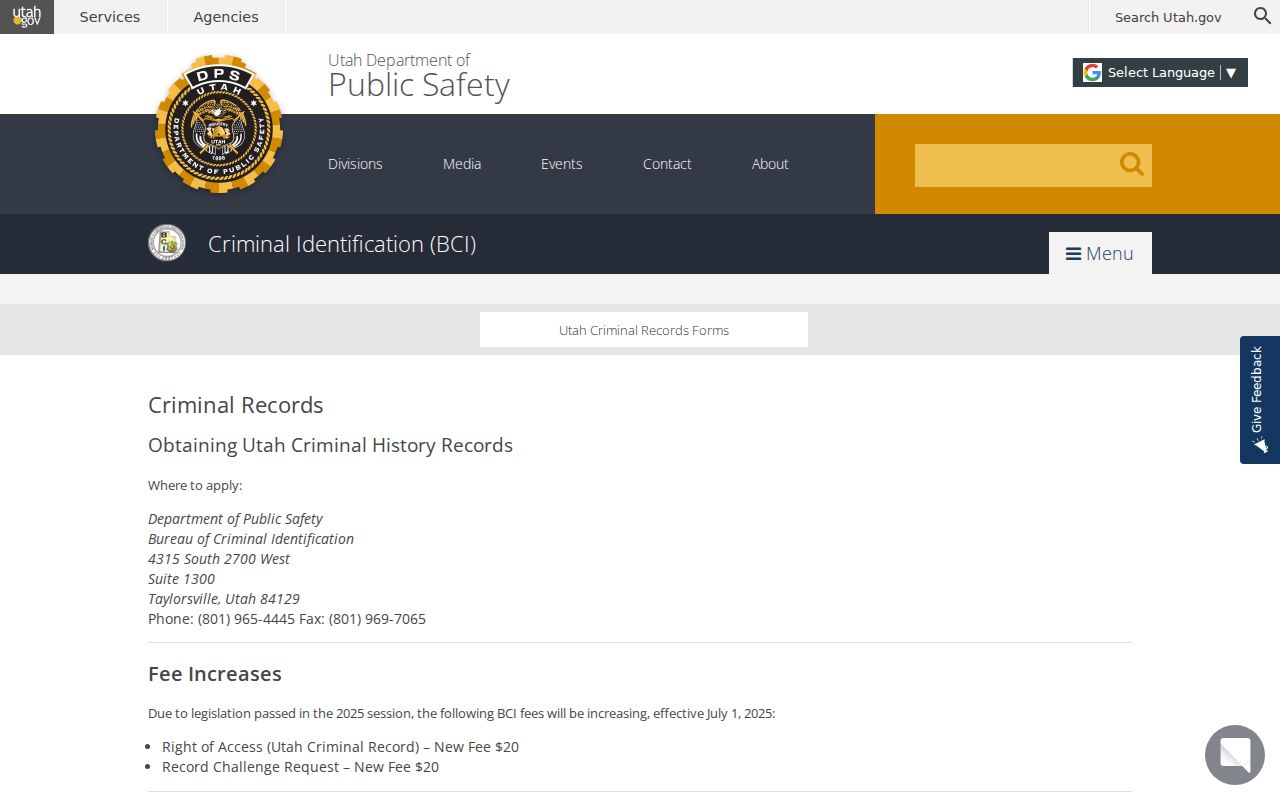
For self-review, BCI Right of Access is Utah's official repository channel. Utah does not provide the public with an unrestricted BCI name search for another person's state history. The applicant supplies fingerprints, a valid unexpired government photo ID, the current form, and a $20 fee. The resulting record is broader than a Wasatch County court search because it can associate fingerprint-supported Utah arrest cycles with reported court dispositions. It is still not the same product as Xchange, and reporting gaps or unmatched dispositions can make the two disagree.
The BCI criminal-records page leads to the subject Right of Access process and the current forms. The image records that official access point rather than a public people-search database.
Wasatch County Sheriff's Office can capture fingerprints on weekday mornings, first come and first served, while Heber Police offers scheduled noncriminal digital or ink printing on Wednesdays. Those services create fingerprint cards or Livescan submissions. They do not produce the completed history by themselves. A nationwide self-review uses the FBI Identity History Summary, another subject-only fingerprint route.
| Official service | Published charge | What it supplies |
|---|---|---|
| BCI Right of Access | $20 | The applicant's fingerprint-supported Utah criminal history. |
| WCSO fingerprinting | $25 for two cards | Walk-in fingerprint capture; credit card only. |
| Heber Police fingerprinting | $35 plus 3% for card payment | Scheduled noncriminal digital or ink service. |
| FBI Identity History Summary | $18 | The applicant's federal identity-history summary. |
No Public Wasatch Criminal Name Search
A BCI record, Xchange result, and sheriff report answer different questions. BCI verifies the identity of the person requesting their own fingerprint-linked Utah repository history. Xchange lets the public search court cases by name and other fields. WCSO releases sheriff-held records through its GRAMA process when the requested material is public and reasonably described. None is a complete public Wasatch County rap-sheet screen.
This distinction matters when a court disposition and repository entry do not match. First, obtain the filed judgment or certified disposition from the correct clerk. Then review the BCI entry and use the agency's Record Challenge Request if the repository record is wrong or incomplete. The challenge costs $20 and requires identity and fingerprint steps. A court screenshot alone is not a certified correction document.
Criminal Record Types
Wasatch County records follow the office that created each stage. A police or sheriff report explains the investigated event. A jail booking shows a custody intake. The County Attorney decides what to file, and the appropriate court creates the docket and judgment. BCI maintains a separate state repository history, while UDC and the Board of Pardons and Parole document later state custody or supervision.
- Incident and arrest reports: WCSO or Heber Police holds the agency narrative, evidence index, and probable-cause material, subject to access limits.
- Bookings: Wasatch County Jail holds intake identifiers, allegations, custody status, bond, release, or transfer data.
- Criminal court cases: District and justice court clerks preserve filed charges, hearings, pleas, orders, judgments, and dispositions.
- Warrants: The issuing court supplies case context, while WCSO can route questions and receive requests for releasable warrant records.
- State records: BCI handles the Utah history, UDC covers correctional status, and the statutory registry serves public notification.
A person researching an arrest should compare the official Wasatch County arrest lookup channels with the filed case. The two records can differ because release, dismissal, amendment, and conviction are separate events.
Four Wasatch County Record Custodians
The Justice Center makes several custodians geographically close, but it does not merge their files. Fourth District Court handles felonies and class A misdemeanors. Wasatch County Justice Court generally hears class B and C misdemeanors, infractions, and unincorporated-area matters. WCSO Records holds sheriff case reports, and the adjoining jail holds booking and custody data. The County Attorney is listed at a separate Heber City address and prosecutes referrals rather than investigating them.
Fourth District Court
Justice Center, Suite 110
1361 S US Highway 40
Heber City, UT 84032
435-654-4676
Wasatch Justice Court
Justice Center, Suite 100
1361 S US Highway 40
Heber City, UT 84032
Confirm the clerk line before a visit.
WCSO Records and Jail
1361 S Highway 40
Heber City, UT 84032
Main: 435-654-1098
Jail: 435-657-1619
Heber Police
301 S Main Street
Heber City, UT 84032
Police: 435-654-3040
Dispatch: 435-654-1411
The Wasatch County Justice Court page identifies its local jurisdiction, while the County Attorney's Office explains the prosecutor's role. Neither office can release a police narrative held by WCSO or Heber Police.
Inside a Wasatch County Criminal Record
The contents depend on which record is open. A BCI product can connect subject identifiers and fingerprints to arrest cycles, charges, the reporting agency, and a disposition or sentence reported back by the court. An Xchange case focuses on the filed proceeding, including parties, attorneys, judge, events, documents, hearings, charges, orders, and outcome. A booking sheet is narrower and tied to custody rather than guilt.
| Name & Identifiers | Name, aliases, birth date, and permitted physical or biometric identifiers vary by product. |
|---|---|
| Arrest / Booking Data | Arrest date, agency, booking number, facility, allegations, bond, release, or transfer may appear. |
| Charges & Statutes | Original allegations can differ from charges filed or later amended by the prosecutor. |
| Disposition | Each count may be convicted, dismissed, acquitted, or otherwise resolved on a different date. |
| Sentence | A judgment may state confinement, probation, fines, or another ordered result. |
| Custody / Supervision | UDC may show inmate, parolee, or probationer status, housing, sentence range, and board dates. |
Read across the whole event cycle. A booking allegation is not a filed charge, a filed charge is not a conviction, and a conviction does not by itself show current custody. The full Wasatch County criminal court case supplies the best place to verify amendments and final judgment.
Wasatch County Jail Record Route
Wasatch County Jail is a 100-bed, medium-security facility at the Justice Center. The official sheriff site did not expose a public searchable roster during research, so the complete route starts with the jail phone at 435-657-1619 for present custody and continues with a written WCSO Records request for a booking sheet or arrest report. State transfer changes the next source: UDC Offender Search covers people incarcerated by or supervised through Utah corrections.
The Utah Department of Corrections provides the official name or UDC-number search entry shown below. Its result can include legal status, housing, offenses, sentence length, board date, parole or expiration date, sentencing court, and case number.
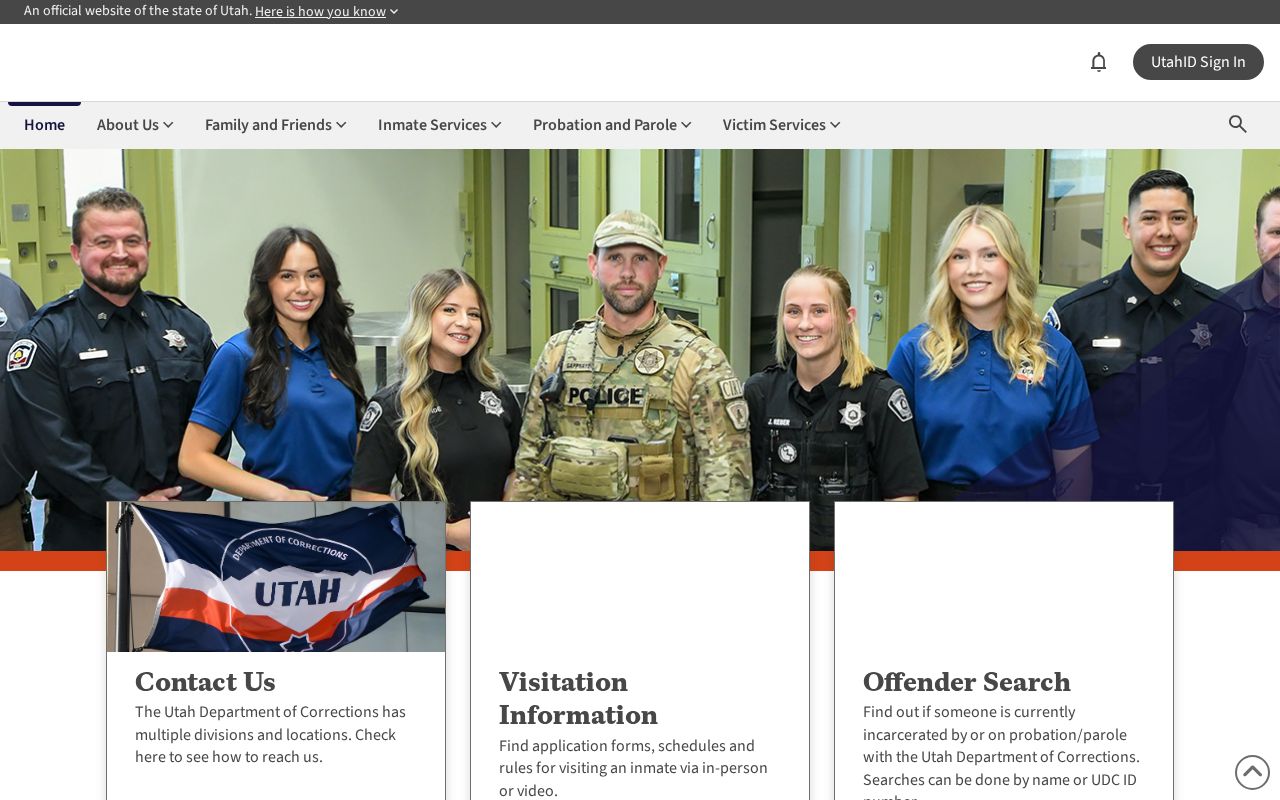
UDC is a state custody and supervision source, not a Wasatch County jail roster. A person held only at the local jail may not appear there, and a UDC result does not replace the underlying court judgment.
Public Access Laws in Utah
Utah's Government Records Access and Management Act, or GRAMA, gives a right to inspect public records but also classifies private, controlled, and protected information. Court records use the Utah judiciary's own classification rules. An agency may redact a victim's details, personal identifiers, active-investigation material, security information, or other restricted content while releasing a segregable public portion.
Key access laws:
Utah Code § 63G-2-201 gives the public-record inspection framework.
Utah Code § 63G-2-204 sets request content and response timing.
Utah Code § 63G-2-302 identifies categories of private records.
Utah Code § 63G-2-305 protects specified investigative and law-enforcement interests.
Utah Judicial Rule 4-202.02 classifies court records for public access.
GRAMA does not force an office to create a new compilation or turn a sealed record public. Describe an existing record with enough detail for the custodian to locate it, and ask for segregable public portions if part of the file is restricted.
Wasatch County Criminal Records Through GRAMA
WCSO accepts its completed case-report form by email at wcsorecords@wasatch.utah.gov, fax at 435-657-3580, or mail and in-person delivery at 1361 South Highway 40 in Heber City. A precise request should identify the incident or case number, date range, record category, and preferred format. State whether you want the incident report, probable-cause statement, booking sheet, jail entry, dispatch record, photograph, body-camera file, or warrant-related record. WCSO requires fees but did not publish a complete accessible fee table, so request an estimate before production.
The official Wasatch County GRAMA gateway is the county-wide fallback captured below. Use the actual custodian whenever it is known because the county portal cannot turn a court file into a sheriff record.
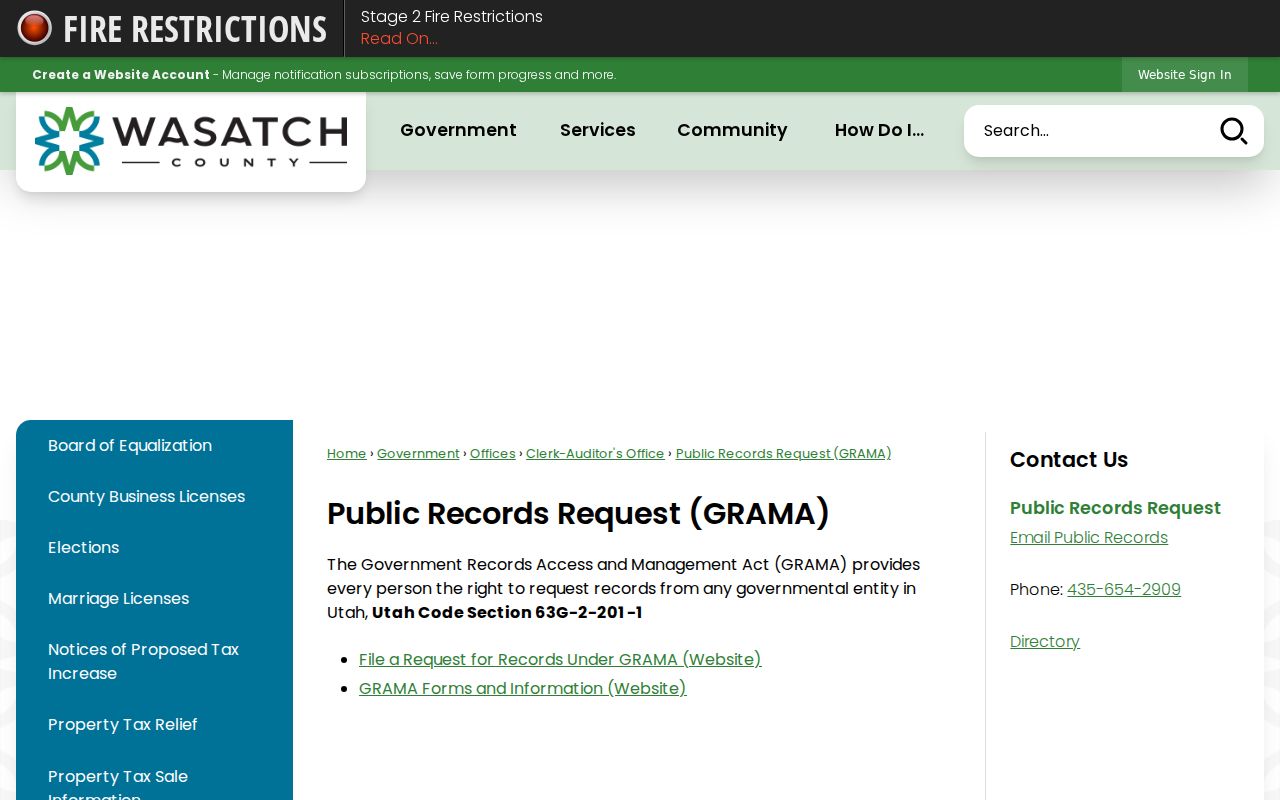
Ordinary GRAMA response time is generally ten business days, with a shorter track for a request that meets the public-benefit basis in the statute. A denial should state the classification and appeal rights. Phone calls help with routing, but a call does not replace the written request.
Sealed, Expunged, and Restricted Records
Utah defines expungement as sealing or otherwise restricting access to an arrest, investigation, detention, or conviction record. Sealed and expunged cases do not appear in ordinary Xchange results, and juvenile delinquency is excluded from the public system. Limited agencies may retain access after relief under Utah Code Section 77-40a-403. A dismissal is different: it is a public case outcome unless another legal restriction applies.
The BCI petition process starts with an application and fingerprints. The current application fee is $65, followed by $65 for each eligible conviction, plea in abeyance, or special certificate. Dismissals, acquittals, and declinations have no certificate fee. BCI states that initial review can take one to two months and does not expedite. Court filing and certified-copy charges are separate, and a certificate does not guarantee a court order.
The BCI expungement page provides eligibility guidance, current processing information, and the official status route shown below.
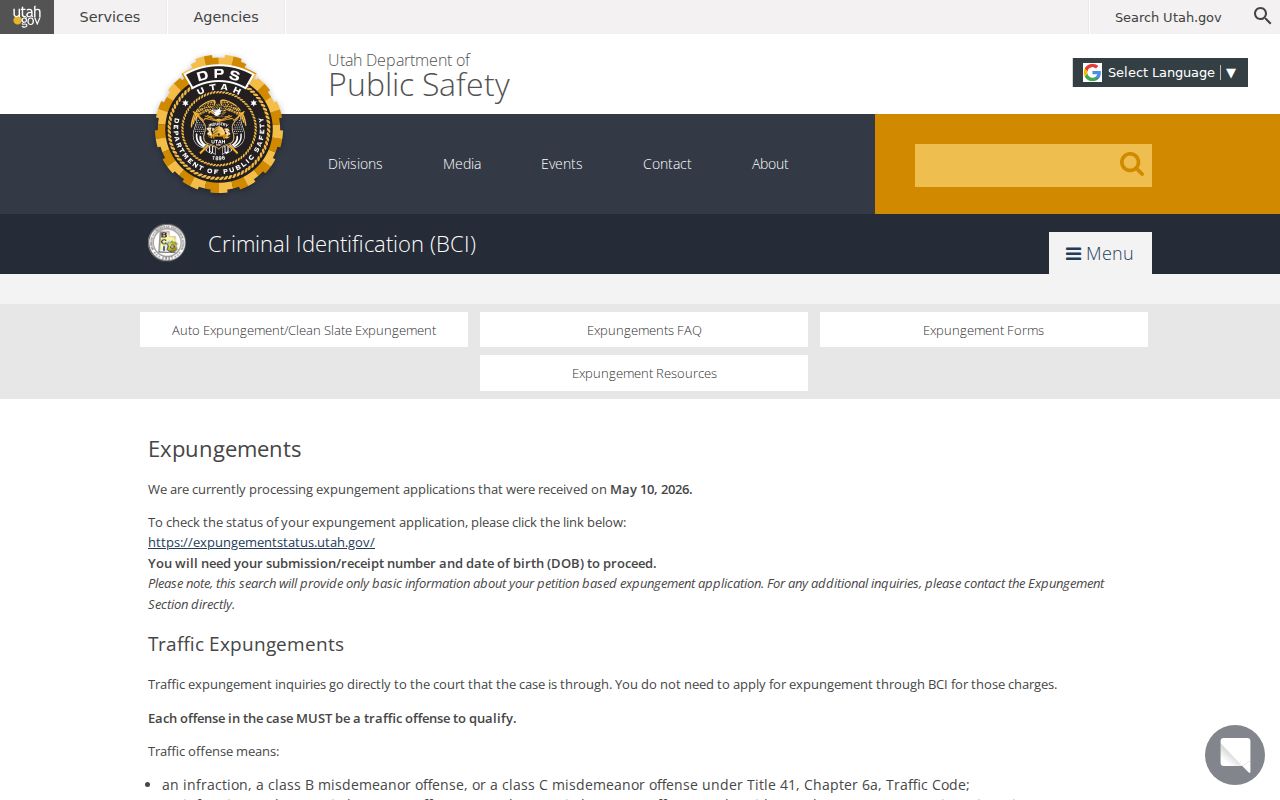
After a judge signs an order, certified copies must reach BCI and every listed arresting, booking, prosecuting, corrections, and court agency. Automatic Clean Slate relief is separate. Because a prior processing pause ended in 2026, verify current implementation before assuming a case cleared automatically.
Correcting Wasatch County Criminal Records
When Xchange and BCI show different outcomes, compare source documents before asking either office to change a record. Confirm the court, case number, every count, disposition date, and later order. Then obtain a certified disposition or agency documentation. BCI's Record Challenge Request is the official repository correction route and costs $20. It uses identity and fingerprint requirements because the agency must tie the challenge to the right person.
- Dismissed
- The court ended a filed count without a conviction, but the public case may remain visible.
- Sealed
- Access is restricted by a legal classification or court order.
- Expunged
- Utah law seals or otherwise restricts covered arrest, investigation, detention, or conviction records.
- Amended
- The filed charge changed after the original allegation, so the final count must be read separately.
- Disposition
- The recorded result for a particular charge, not merely the status of the case as a whole.
A correction request should name the disputed event and attach the strongest official proof available. That keeps a data challenge focused on a specific Wasatch County criminal record rather than asking BCI to infer an outcome from an incomplete search result.
Wasatch County Criminal Records by City
Agency boundaries shape a local records search. Heber Police writes city reports and maintains Heber Justice Court contacts. Midway now contracts with Heber Police for law enforcement, but lower filed cases generally route to Wasatch County Justice Court unless the charging document names another venue. Hideout contracts with WCSO for all law-enforcement services and has no separate police records unit, jail, or municipal court. The cards use the official 2020 Census ranking so all three places share the same population vintage.
Heber Criminal Records
16,856 · Heber Police reports, city justice records, and county bookings follow separate routes.
Midway Criminal Records
6,003 · Heber Police provides contracted service, while WCSO holds county jail bookings.
Hideout Criminal Records
922 · WCSO handles reports and bookings for the town under contract.
Population size does not decide the custodian. The arresting agency, booking facility, and court named on the charging document determine where a Wasatch County criminal record must be checked.
Wasatch County Corrections Record Search
After a Wasatch County case reaches state custody or supervision, UDC and the Utah Board of Pardons and Parole become important. Adult Probation and Parole supervises qualifying district court probationers and parolees. The Board makes parole decisions in Utah's indeterminate sentencing system. UDC Offender Search can show legal status, housing, sentence range, sentencing court, case number, board date, and parole or expiration information, but sensitive supervision conditions are not generally public.
The Utah Board of Pardons and Parole describes the parole authority whose official page appears below.
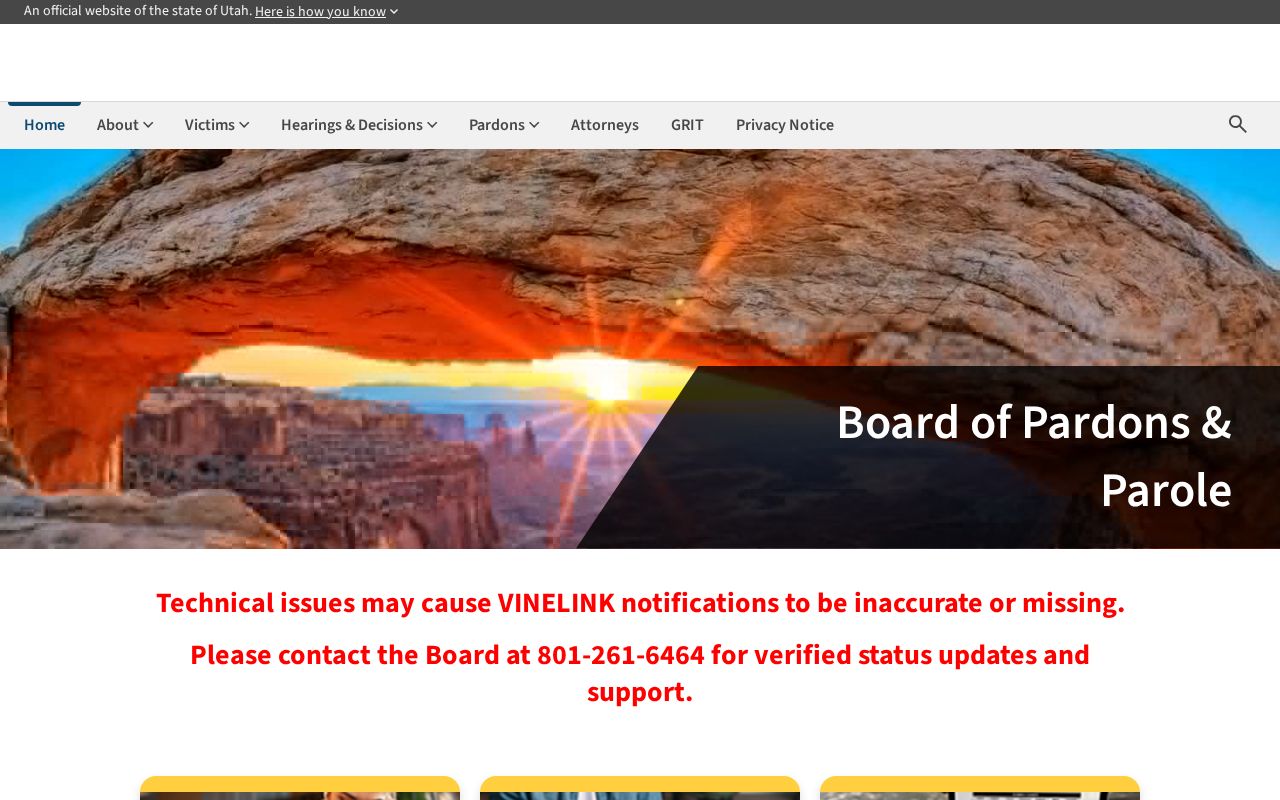
Board information belongs at the later correctional stage. It does not prove what happened at arrest, and it cannot replace the Wasatch County court judgment that created the sentence.
Wasatch County Criminal Records Campus
Wasatch County's justice geography is unusually concentrated. Fourth District Court, Wasatch County Justice Court, Juvenile Court, the Sheriff's Office, and the county jail share the US-40 campus in Heber City, even though each keeps a distinct record. Corrections deputies screen entrants, support all three court levels, and move incarcerated people from the adjoining jail to hearings. The County Attorney now has a separate office at 805 West 100 South.
Rapid population growth helps explain the campus expansion. Wasatch County rose from 34,788 residents at the 2020 census base to an estimated 38,514 in July 2025. Phase 1 opened in December 2025 with new state and juvenile courtrooms, chambers, offices, security, and holding space, and full completion was scheduled for August 2026. The change affects courtroom capacity, not the rule that each requester must identify the right custodian.